Retail, Retail Marketing, Retail Media, Thought Leadership
Retail Location Profiling: The Foundation of Marketing, Retail Media and Estate Performance

Retailers operate some of the most complex physical environments in modern commerce.
Hundreds, often thousands, of locations.
Different formats.
Different layouts.
Different fixtures.
Different demographics.
Different needs. Different opportunities.
Yet the performance of these environments often depends on fragmented, outdated or inaccessible store data. Sound familiar?
The common denominator? A lack of structured Retail Location Profiling.
Retail Location Profiling is not simply record keeping. It is not a static database. And it is not an administrative task.
Retail Location Profiling is a centralised data framework, distinct from standard CRM or Inventory Management, that maps all the characteristics of a retail estate.
It is the operational foundation that connects marketing, operations, retail media, estate management and commercial strategy, improving efficiency and turning store-level information into revenue-driving infrastructure.
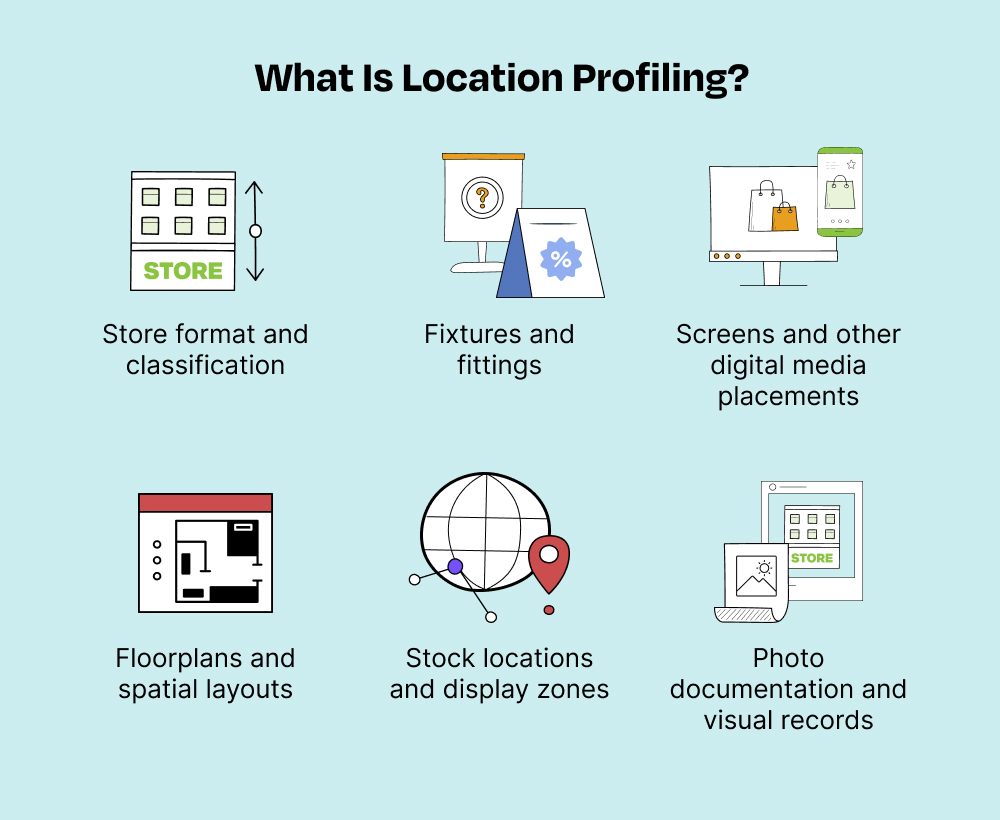
Retail Location Profiling is the structured capture, governance and activation of detailed intelligence about each physical retail (or other) location.
A comprehensive location profile includes:
If something exists in a store, it should exist in its location profile.
It can also include information like customer demographics, product ranges and departments, highest footfall areas and other commercial data that can help retailers to utilise and monetise their store spaces fully.
When that information is centralised, searchable, permission-controlled and continuously updated, it becomes a strategic asset rather than static data.
Retail Location Profiling transforms store knowledge into structured intelligence.
Many retailers still manage location information across spreadsheets, shared documents, email threads, local files and individual team knowledge. This fragmentation creates operational drag – too many meetings, slow approvals, and manual, repetitive tasks – across the organisation.
Retailers face multiple, overlapping pressures:
All of these depend on one prerequisite: Knowing your locations in meticulous detail.
Retail Location Profiling provides clarity across three critical business functions:
Without it, performance is constrained by uncertainty. Decision-making relies on assumptions rather than verified intelligence. And, there are countless missed opportunities in Retail Media.
Marketing execution in multi-location retail is complex. No two stores are identical.
They differ in layout and flow, available display capacity, fixture configurations, customer demographics, competitive surroundings and more.
Yet campaigns are often planned at a national level and distributed with limited store-level precision.
This leads to one-size-fits-all allocations, excess inventory shipped “just in case”, materials produced that cannot be installed and very limited local targeting and relevance.
Thorough Retail Location Profiling enables a different approach. With structured location intelligence, marketing teams can:
Instead of asking:
“Does this store have this?” “Will this fit?”
Teams can ask:
“Where will this perform best?”
Location Profiling shifts marketing from distribution-based execution to precision-based activation.
How does accurate store profiling reduce retail marketing waste?
Uncertainty is the primary driver of overproduction in retail marketing. When central teams lack confidence in their store data, they are forced to hedge their risks to ensure campaigns don’t fail at the point of sale. This lack of visibility leads to a culture of “just in case” logistics, where brands habitually print extra units, send surplus materials, and standardise sizes unnecessarily to cover the gaps in their knowledge.
The cost of this guesswork is staggering. Industry research suggests that between 30% and 50% of produced in-store marketing materials may never actually be installed. This isn’t just a missed opportunity; it is a significant drain on the bottom line that encompasses direct production costs, inflated logistics expenses, and the eventual cost of disposal.
Retail Location Profiling transforms this landscape by replacing assumptions with granular data, enabling a shift toward true precision allocation. By maintaining a living record of every fixture and fitting, retailers can move to store-specific material allocation and automated kit building. This ensures that every size and quantity is accurately matched to the physical reality of the estate, supported by clear installation instructions and verified placement tracking.

Retailers are rapidly monetising their physical estate through retail media.
Window displays, endcaps, FSDUs, sampling zones and digital screens are now revenue-generating assets. But, in-store retail media is only scalable when inventory is clearly defined and operationally governed. To sell confidently, retailers must know:
Without structured Location Profiling, media operations remain manual and fragmented.
Sales teams rely on static lists and verification requires manual reporting.
Retail Location Profiling changes this dynamic.
By mapping fixtures and media spaces directly within each location profile, retailers can:
Effective estate management begins with a “Know Your Property” (KYP) strategy. To maximise asset value and ensure total operational efficiency, teams must transition away from fragmented spreadsheets towards a centralised, comprehensive real-time database of every retail location.
Without centralised intelligence, estate teams face limited visibility of asset distribution, inconsistent format standards, difficulty planning refurbishments and inefficient lifecycle tracking.
With structured Location Profiling, estate teams gain:
This enables:
When marketing, operations and property teams operate from the same location intelligence, organisational alignment improves.
Retail Location Profiling becomes a shared foundation.
Spreadsheets store information. Detailed, thoughtful, accessible Location Profiling creates control.
A structured platform enables retailers to:
Instead of manually validating store details before every campaign, teams operate with live, trusted intelligence.
Instead of asking stores for updates via email, changes are logged centrally.
Instead of fragmented knowledge across departments, the business operates from one version of truth.
This reduces friction. It accelerates planning. It increases accountability.
And it supports scale without adding proportional headcount.

When implemented effectively, Retail Location Profiling drives profitability across three levers:
More precise segmentation
Better localisation
Higher campaign performance
Correct quantities
Reduced waste
Lower production costs
Simplified installation
Defined inventory
Omnichannel package availability
Verified execution
Advertiser confidence
Scalable revenue
Research indicates that more than 80% of retailers want to introduce software to streamline how they manage location data.
Retail leaders recognise that fragmented store information limits speed, accuracy, accountability and profitability.
Retail Location Profiling addresses the root cause. It transforms store data from an administrative burden into a strategic capability.
It enables retailers to:
In complex estates, clarity is a competitive advantage.
Comprehensive and meticulous Retail Location Profiling is not a marketing add-on. It is not a compliance tool. It is not a one-time data project.
It is operational infrastructure that underpins:
Retailers that treat location intelligence as infrastructure gain structural advantage.
They move from reactive coordination to proactive control.
There is a shift from assumption-based planning to verified execution.
They build scalable revenue models on top of trusted physical assets.
In multi-location retail, performance depends on precision.
Before retailers optimise campaigns, sell media or reconfigure formats, they must know their locations in detail. When location intelligence becomes centralised, governed and connected across teams, it becomes more than data. It becomes control.
Colateral offers this flexible, business-owned location intelligence layer as part of its retail media technology.
Get in touch to see it in action.
 Retail Media, Thought Leadership
If you’re running a Retail Media Network (RMN), your physical store estate is your most...
 Retail Media, Thought Leadership
Retail media networks (RMNs) aren’t just the hot topic in retail — they’re quickly becoming...