If you’re running a Retail Media Network (RMN), your physical store estate is your most valuable, yet often most challenging, asset. You know the revenue potential is immense. Your suppliers are demanding precise, compliant, and measurable in-store activation.
But the reality? Your physical media estate is likely a mess of fragmentation:
- Inventory: Store-level fixture data is in one system (or an outdated spreadsheet).
- Complicated Business rules: Make selling harder and harder to find unsold inventory.
- Booking: Media sales teams use separate documents to sell inventory slots.
- Proof of Play: Store execution compliance is tracked via manual emails or a separate photo-sharing app.
This fragmented approach doesn’t just create operational headaches; it actively blocks revenue. It makes your inventory unbookable, your execution unreliable, and your network impossible to scale.
We’re here to show you how establishing a Single Source of Truth for your store data, physical inventory, store attributes, and compliance status.
This is the crucial step to supercharging your RMN and driving significant year-on-year revenue growth.
The Retail Media Revenue Trap: Why Fragmentation Kills Bookability
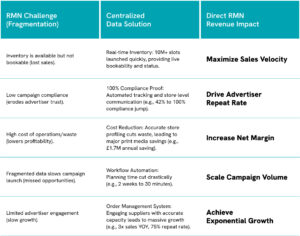
For a physical RMN to succeed, its inventory must be accurate and consistently available. Fragmented data prevents this, leading to the “Revenue Trap” where potential sales are lost simply because inventory can’t be confirmed.
1. Unbookable Inventory is Lost Revenue
When store profile data is decentralized, your media sales team can’t confidently sell an in-store slot.
- Capacity Confusion: Can this specific store format fit a free-standing display? Is that shelf space already dedicated to a seasonal promotion? Without real-time data, media capacity is available, but often not bookable.
- Unsold Inventory: How much inventory goes unsold, due to partial inventory sales and due to spreadsheets and fragmented data?
- Slow Inventory Ingestion: Manually verifying and updating your media estate is slow. One major grocer with over 1700 stores was limited by a lack of detailed knowledge about the supply and availability of their advertising assets. Centralization helps overcome this and instantly makes inventory available for booking.
2. Compliance Uncertainty Undermined Performance Reporting
Retail media advertisers pay for guaranteed visibility and results. When you can’t prove compliant execution, you erode trust and risk losing repeat business.
- The Compliance Gap: A centralized system ensures you have clear governance in place to guarantee compliance in every location. Without it, compliance levels can be dangerously low, as was the case for one retailer, which saw in-store campaign compliance at just 42% before implementing a centralized solution.
- The Cost of Non-Compliance: If you don’t know where your media is live, you can’t measure its impact, and advertiser trust will quickly erode. In the modern Retail Media landscape, this is a non-negotiable requirement
3. Inefficient Workflows Waste Resources (and Money)
Manual processes driven by fragmented data pull valuable, specialized RMN staff away from selling and account management.
- The Operations Burden: Teams waste time reconciling sales against store inventories, manually allocating materials, and chasing proof-of-play. For one grocery retailer, centralization streamlined processes and removed mistakes, leading directly to revenue growth.
- Reduced Team Efficiency: By automating these administrative tasks through centralization, a leading regional US grocer drove significant growth using only two full-time employees managing the whole program.
The Centralization Advantage: 5 Pillars of RMN Growth
A single platform that ingests full product, store, hierarchy, and adjacency data in real-time transforms your RMN from a high-maintenance operation into a lean, scalable profit center.
1. Real-Time, Scalable Inventory Management
Your first step to scale is knowing exactly what you can sell, everywhere.
- Live Availability: Centralization gives your media sales team access to live availability and status overviews for every reservation at their fingertips. This confidence allows you to increase sales volume and maximize revenue.
- Data-Driven Decisions: The platform utilizes all data to help you make live, strategic retail media decisions. You can easily identify underutilized inventory and create new, bookable media units.
2. Unbeatable Campaign Execution and Compliance
High compliance builds the foundation for long-term advertiser relationships and repeat spend.
- Guaranteed Execution: Tools can track campaign display compliance and ensure your marketing is always installed correctly. This consistency is key to delivering on media contracts.
- Perfecting Compliance: Achieve compliance by implementing a system for seamless communication and easy distribution of channel assets. High compliance is the direct route to high advertiser renewal rates.
3. Cost-Effective In-Store Operations
Centralization is not just a revenue driver; it’s a major cost-saver, which directly boosts your RMN’s profitability.
- Minimizing Waste: By ensuring marketing materials are perfectly allocated based on accurate, detailed store profiles, you only produce the materials each store needs. This targeted approach reduces print and distribution waste.
- Huge Annual Savings: Focusing on accurate store data and campaign control led one leading supermarket chain to a £1.7 million reduction in their annual in-store marketing costs. That’s bottom-line money that drops straight into your RMN’s profitability analysis.
4. Exponential Revenue Growth
The most compelling benefit is the ability to grow your sales with limited overhead.
- Increased Advertiser Engagement: By making your network easy to buy and reliable to execute, you engage a much larger portion of your suppliers. A leading regional US grocer engaged more than 400 advertisers after implementing a centralized order management system.
- Driving Repeat Spend: Advertiser repeat rate is the single most important metric for RMN sustainability. The same grocer reported a 75% advertiser repeat rate. This indicates high satisfaction with execution and results—a direct outcome of reliable, centralized data.
- Multi-Fold Sales Increases: The ultimate prize: The focus on order management and demand generation powered by centralized data helped one regional US grocer achieve 3x retail media sales year-over-year.
5. Advanced Measurement and Optimization
Centralization allows you to transition from simply tracking tasks (Did the POS go up?) to tracking outcomes (Did the POS drive sales?).
By linking campaign data, compliance proof, and sales metrics, you can accurately:
- Measure Effectiveness: Collate campaign performance, POS data, and customer information to measure effectiveness in every location.
- Optimize Spend: Double down on the media units and creative executions that generate the highest ROI, guaranteeing continued growth for your RMN.
The RMN Data Strategy for Scalability
Conclusion
The difference between a successful Retail Media Network and one that constantly struggles is data management. Fragmentation forces your RMN to play defense, constantly reacting to errors and chasing manual compliance.
Centralization allows you to play offense. It transforms your physical store estate into a highly accurate, measurable, and scalable media platform. By investing in a Single Source of Truth, you are not just buying a system; you are buying speed, guaranteed execution, advertiser trust, and, most importantly, the ability to unlock the full, multi-million-dollar revenue potential of your RMN.
It’s time to build a robust foundation for the growth your network deserves.

 Retail Media, Thought Leadership
 Retail Media, Thought Leadership